
140. Right to Left Law Practice: Better Outcomes by Beginning at the End
Show Notes
When you’re trying to improve something in your law practice, starting at the beginning might seem like the obvious approach. But I’ve found that working backward from the outcome you’re trying to achieve can be a much more effective way to think about everything from daily workflows to long-term strategy.
In this episode, I’m exploring a concept from Mike Burrows’ book Right to Left and how I’ve applied it in my work with law firms. I’ll walk through several examples of what this approach looks like in practice, from moving matters through a Kanban workflow to setting business goals and designing processes around the people they’re meant to serve.
You’ll learn why focusing on the end result can help you make better decisions about where to direct your team’s attention, how to approach process improvement, and how to engage clients in their own legal matters. I’ll also explain why the outcomes you’re working toward should guide your strategies and tools, rather than the other way around.
Take your law practice from overwhelmed to optimized with GreenLine Legal
Follow along on LinkedIn: linkedin.com/in/johnegrant
What You’ll Learn:
- Why approaching your law practice from right to left can lead to better decisions and outcomes.
- How prioritizing matters closest to completion can improve workflow and free up capacity.
- Why your firm’s mission and goals should guide its strategies, activities, and technology choices.
- How to use a SIPOC chart to design workflows around the needs of their intended customers.
- Why treating clients as suppliers of essential information can improve your legal processes.
- How client journey mapping and strategic planning can help clients stay engaged in their matters.
- Why revisiting and adapting client strategies is an important part of an Agile approach.
Episode Resources
- Ep #001: Four Agile Principles to Help Your Legal Practice
- Ep #016: Aligning Your Firm's People and Systems with Tim Lennon
- Ep #025: Following Your Law Firm Strategic Plan with Melissa Shanahan
- Ep #104: Quality Standards for Law Firms: How to Make Expectations Explicit and Work Predictable [Agile Lawyering Part 4]
- Ep #108: The Client Journey Map: A Systems Tool for Better Client Experience and Law Firm Flow [Agile Lawyering Part 8]
- Ep #110: Why Every Legal Matter Needs a Strategy Plan [Agile Lawyering Part 10]
- Ep #120: Get Curious Before You Get Defensive: Clean Language Questions for Lawyers
- Right to Left: The Digital Leader’s Guide to Lean and Agile by Mike Burrows
Current Resources and Offers
Work with John E. Grant, the world's leading expert on Agile Attorney practices.
Transcript
Read Transcript
Long-time listeners know that one of my favorite things to do on this podcast is to bring concepts from outside of the legal profession and explain how they can be adopted and adapted to help lawyers and their teams do better work.
Today's version of that is a simple idea from a great book that wasn't written with lawyers in mind. And years after I first read it, I am still finding new places in my consulting practice where it applies. And today, I'm gonna walk you through a few of them, including ways to create a better strategy for your law practice, better flow for your work, and better relationship with your clients.
You're listening to The Agile Attorney Podcast, powered by GreenLine. I'm John Grant, and it is my mission to help legal professionals of all kinds build practices that are profitable, sustainable, and scalable for themselves and the communities they serve. Ready to become a more Agile Attorney? Let's go.
Hey, everyone. Welcome back. So this week on the podcast, I wanna talk a little bit, maybe at a higher level than I sometimes do. And I know I can get pretty practical, tactical, but there is a way of thinking that I have learned and adopted over the years that I think makes a huge difference in my effectiveness and sort of a day-to-day basis. Certainly, the way that I approach my work both with my consulting clients and now more and more with our GreenLine customers as they're coming on and adopting the tool. And that is sort of this break from a traditional way of looking at a need, a problem, a goal, and sort of approaching the setup from left to right. Right?
It's really simple when we think about planning to want to do what Julie Andrews talked about in The Sound of Music. Right? To start at the very beginning, the very good place to start. And I get it, and it sometimes conceptually is easiest to start at literally the starting point.
But the thing that all of this training in agile, in the Kanban methodology specifically, has taught me through the years is how incredibly powerful it is to switch that perspective and approach your problems not from left to right, but instead from right to left.
This isn't a totally unique concept. Right? You may have heard things like begin with the end in mind that are encouraging you to get to that end state, to get to that desired state, to get to whatever the deliverable needs to look like, and then sort of work backwards from there. But the particular lens that Agile thinking in general puts on it, and then very specifically, the work of a guy named Mike Burrows. I think, I'm sure I brought him up before in the podcast, probably when I talked about clean language questions.
Mike actually has a book called Right to Left, and I highly recommend it. I'll put a link in the show notes. It's one of many books he's written, but in some ways, it's kind of maybe the simplest or the most straightforward in terms of how adopting this right-to-left mindset can really improve your approach to problem-solving in any number of domains.
And I'll start by talking about how it works in a Kanban system only because it's something that has been coming up more and more as we've been onboarding people into GreenLine, regardless of what the workflow is that we help them build, help them set up.
Our whole goal with GreenLine is to get that basic workflow, you know, whether it's, again, litigation, transactional, whatever it happens to be. We wanna define those stages of work as columns on the board. We get some other things, like card labels and things defined, but then we want to build your workflow and import your actual matters into the tool as quickly as we possibly can. Our goal is to try to get it done within a week. It doesn't always happen because we need a little more configuration, or maybe we need to get some help with an export.
But we're really pushing to make the work visible and get the workflow visible inside of the tool as quickly as you can, because then that creates this world where you're now iterating off of this sort of minimum viable workflow, if you will, and getting into this Kaizen or this continuous improvement methodology. But one of the things that inevitably happens is once we've imported the cards, there wind up being a whole lot of cards way kind of at the far right of the workflow.
So whether it's an estate planning workflow, an immigration workflow, a litigation workflow, there almost always is a column towards the end right before you get to the done column. And I don't know if I've ever said this on the podcast, but the done column is green in GreenLine. That is literally the green line we are named after.
So the whole purpose of the tool is to get things into the done column to get them across the green line. And, unfortunately, for a lot of workflows, sort of like salmon gathering at the pool below a waterfall, work tends to really gather right before that done column. The work likes to pile up, and it's usually this sort of finalize and close or close and wrap up. It's all those little things in the workflow that are often administrative. Right?
Sending the disengagement letter, getting the final bill out and paid for, closing the matter in all of your systems, getting copies of the client file to the client if that's a thing that you do. It's these administrative tasks. And they never, hardly ever, rise to the level of urgent. Right? There's always something that is, like, flashing more brightly or beckoning more loudly inside of the practice, and the work just piles up in that part of the workflow.
But as I said, my practice is to always, always approach a Kanban board from right to left. Again, the goal of the system is to get things to done. The metaphor I often use is we want to imagine that the done column has a magnet in it, and that all of the cards on your Kanban board are also magnetized. And metaphorically, what I'm trying to illustrate is that the closer cards get to the done column, the stronger they should feel the pull of that magnet. Right?
There may be reasons that it can't get across a line, but we want a system that is pulling that work into done as much as we can. Because when you cross that green line and you get things into the done column, three really good things happen. Right? Number one, you get paid, and you may have been getting paid along the way. But, again, the final bill comes in. That's usually a good thing. Right? We like that.
Number two, the client gets finality. And, hopefully, you've accomplished the goals that they had for the matter, depending on your practice area. That may not always happen. Right? Litigation can go either way. Sometimes, the realities of the world don't let people accomplish their goals. But either way, you've done the best for them that you can, and you've achieved a state of finality or certainty, hopefully. And now the client can sort of not worry about this particular legal matter anymore, which most people don't want to be worrying about legal matters. That's a good thing.
The third good thing that happens is by pulling it into the done column, and eventually, in GreenLine at least, we've got this auto-archive. So once you pull it into the done column, it's eventually gonna get archived after however long you choose, usually a couple of weeks. But it clears it off of your board. It creates space. It creates capacity inside of your practice because nobody has to use any more of the firm's finite time and attention worrying about that matter anymore.
So we like the done column because it's off our plates. And that's an example of this right-to-left thinking that I'm talking about, by approaching things that are closer to done first and then kind of working backwards to those things that are newer, fresher.
Again, that's not to say that there won't be times that we have to go focus on intake or focus on something where there is a time sensitivity, or focus on something just because we know that we want to engage a client both technically, legally, but also psychologically. And therefore, there's some advantages to working on the front part of the board in the early phases of a matter.
So I'm not saying it's a, like, a hard and fast rule, and you only ever work a board from right to left. But the default in my mind should always be approaching the work in a way that the things that have been in process the longest or that are closest to achieving whatever outcome they're supposed to achieve, those are the ones that get your early attention because all of the good things that happen when you cross that green line into the done column.
But this right-to-left thinking isn't limited to that, and this is where Mike's book gets really interesting because he looks across a lot of process improvement and workflow and strategic paradigms. And it's his contention that what a lot of them have in common is an emphasis on this right-to-left thinking.
And I'll give you a couple of other examples of how I've been using it in my various practices. Some of these I was doing before I started learning from Mike. Some of these, I've been doing a lot more intensely since I have worked with Mike. I did a workshop with Mike a couple of years ago. It was fantastic, and I've been a big fan of his book. So I give Mike a lot of credit for this.
The methodology, though, that I have been doing for long since before I knew Mike, is this high-level concept I have around overall business strategic setting, goal setting, strategic planning. And I think I've talked about this before. I forget which episode.
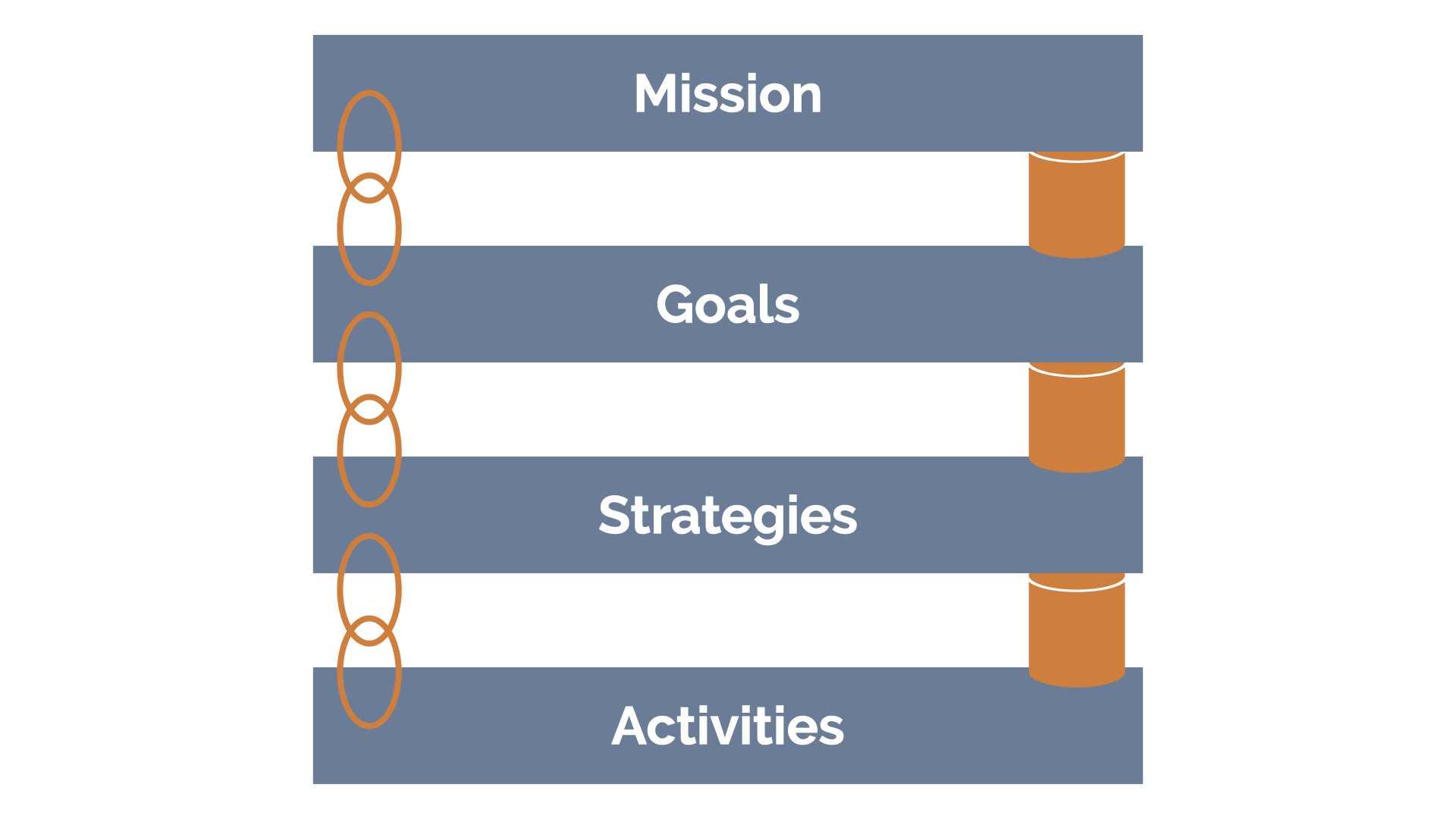
I've got a graphic, and I'll put that graphic in the show notes. But I think of any business, and particularly a law business, as having four high-level domains of activity. And sometimes those domains are illustrated in, like, pyramid. There's either, like, a normal pyramid with the base at the bottom. I sometimes see them drawn as a reverse pyramid.
I never liked either of those pyramid illustrations, and so I just write them all of equal sizes. And so at the top level domain, you have the mission level, which is often mission, vision, values, purpose. I know I've talked about building a purpose-driven law practice, and I'll put the link to episode in the show notes as well. But it's basically why is this business on the planet. Right?
What is the change we hope to create in the world as a result of this law firm or this legal business existing? And, yes, it's to make money. I get that. We live in a capitalistic society, but that's not, hopefully, the primary purpose. Right? Hopefully, you are trying to create some sort of positive change for some population that you care about. All the things I talk about at the top of every episode. Right? The communities that you serve.
And then as you go down a level, I think of that as the goals layer. Which is to say, what are the specific targets we can set, or the specific outcomes we're trying to achieve that are measurable, tangible. I do like the SMART goal format. I won't dive deep into that today. But the things that you can actually put on paper and say, yes, we did that, or no, we fell short of that.
That's the goals layer, and it's a layer down for mission. Right? They tend to be a little bit shorter-term. Right? Mission is often a sort of pie-in-the-sky thing. It's like, we may never fully accomplish our mission, but the world will be a better place for every increment of progress we make towards it. Goals tend to be a little bit shorter term, right, maybe at most on a one- to three-year basis, sometimes all heck of a lot shorter. But, again, the thing that a goal has different from a mission is I think they tend to be very measurable and ideally time-bound. Right? Two parts of that SMART goal formulation.
The next layer down from that is the strategies layer, which is what are the specific things we're going to try in order to accomplish the goals that we've set. Right? And strategies can be procedural. They can be different ways of working and communicating with each other. They often involve tools and technology.
But basically, if we have a goal, and I'll make up a random one, which is we have a goal to serve 100 more clients next year than we did this year. What are the strategies we're gonna have to recruit in order to accomplish those goals? Right? And it's gonna be some combination of maybe biz dev and marketing improvement. That's a strategy. And then inside of that, there could be specific strategies around better SEO, or we're gonna hire a cold caller, or, you know, whatever it is, social media posting, content marketing. Right? These are all sub-strategies of the biz dev strategy.
We also need to have a workflow strategy, and so that's where a tool like GreenLine comes in. Right? We're going to try to adopt a more Agile way of working, and in order to adopt that Agile way of working, we're going to use a tool like GreenLine to support the overall methodology.
But the point is, is that the strategies are experiments, number one, and they are experiments that you're running in support of the goals, which are in support of the mission. And so you can start to see how this starts to incorporate this right-to-left thinking, where the mission is on the far right. And then the goals are a little bit upstream of the mission. The strategies are a little bit upstream of the goals.
And then the fourth layer that I haven't talked about yet is the tactical layer or the activities layer, which is, okay, what are we going to do day in and day out? What are the specific tasks that we're going to recruit the team or otherwise try to accomplish, because they're in support of the strategies. Right? If you're gonna have a content marketing strategy, you need to have a content calendar. And that means the activity you need to be doing a lot is creating content. And so those activities are in support of the strategy, are in support of the goals, are in support of the mission.
And this sort of right-to-left approach is a far more effective way than what I often see with a lot of businesses, not just legal ones, which is this more spaghetti-on-the-wall approach, which is, hey, I think we should try document automation, or we should be using more AI in our practice. That's an intent, and that's an intent around a tool, which I think maybe suggest a strategy, but it's not an inherent good. Right?
What are you trying to accomplish with more AI in your practice? Well, we're trying to create more five-star reviews from our clients, create a better client experience. That could be an interesting one. Again, we're trying to improve volume. We're trying to improve quality. I think all of those are valid reasons to do it, but I wanna start with those goals.
What are we trying to accomplish before we get fixated on the tools? It's one of the biggest mistakes I see, frankly, in legal practice. And, you know, I know we're just coming off of ClioCon a few weeks ago and some other big legal technology and marketing events. There's a lot of marketing in our industry that is trying to dazzle you with features and sort of what-ifs and what it can do. And I think there's a lot of great, amazing things that can do really cool stuff. However, if they aren't gonna help you accomplish your specific goals, then those capabilities are irrelevant. It doesn't matter.
There's this other really specific way that I incorporate this right-to-left thinking when I'm working on workflow problems or process problems, and that's the use of a tool that comes from the world of Lean, Lean manufacturing, called a SIPOC chart. It's an initialism. It stands for suppliers, inputs, process, outputs, and customers.
But when I build a SIPOC chart... So, basically, when you're defining a workflow, when you're trying to improve a workflow, you create these columns on a whiteboard or on a piece of paper and label them all again with those five labels. And then, by thinking through what should be happening at each of those columns, that really helps you sort of get to a better sense of how to orient your team and your tools and your technology around the correct process to produce the outcome that you're trying to achieve.
And, again, the way that I think of this as being a right-to-left thing is that I almost always never fill out a SIPOC chart from left to right. I almost always produce it from right to left.
So when I'm approaching a workflow issue, the first thing I wanna know is who are the customers, or who is the customer if there's only one, or the customers if there's more than one. And as I'm sure I said before, a lot of legal processes have more than one customer. Right? Pleading, yes, there's a customer who is the court, but also your opposing counsel or opposing party as a customer.
Also, your client is a customer of that document. And so understanding who all it's supposed to be serving is a big part of understanding the process overall. From there, understanding what does the output look like. What is the actual tangible deliverable that we have to produce for that customer?
And, again, with a pleading, it has to be at a specific format. It has to have certain information. Probably has to be in a specific font and filing it. Right? There's a lot of rules about it, but then there also are the more intangible ones. Like, how are we gonna make sure that it has the information in it that is compelling for the court as a customer, opposing party or counsel as a customer, and even for our client as a customer?
Then we work backwards from there. What is our process for creating this document? I often actually save process for last, partly because the thing that I wanna get to when I'm doing this process improvement work is going even upstream of process, which is what are the inputs. Right? What are the raw materials or the ingredients we need: the information, the documents, etcetera? Maybe the legal research we need to do in order to execute the process in an efficient way.
So we don't have to start the recipe, find out we don't have eggs, put everything on hold, run to the store, or go knock in a neighbor's door, and then come back and write who knows what's happened. Stuff's been sitting out on the counter getting weird while you're going back and finding all the things. The same thing is true in your legal work.
So, yes, I wanna know what the process is, but I really want to define what are the inputs we need, all the different flavors of inputs, and then upstream of that, who are the suppliers for those inputs? Where are we going to get the stuff that we need?
And I'll do a quick little aside because this comes up all the time when I'm doing this SIPOC chart work. One of the biggest challenges and, frankly, mistakes that law practices make is, yes, your client is a customer of most of your processes, but they also are the supplier for most or a good chunk of the raw materials you need to execute your work. And one of the biggest problems I see in terms of law firm workflows is firms that spend too much time treating their client as a customer and not enough time managing them as a supplier.
And I think if you, in your intake, in your engagement, in your initial consultations, in your strategy sessions, whatever happens to be, spend more time explaining to your client that, yes, they are your customer. But right now, the most important thing they can be is your supplier. You need those bank statements. You need the family tree. You need the documentation, the photographs, whatever it is for whatever legal issue you handle. Really making sure you're deputizing the client as a supplier is gonna really help get you the things you need more quickly. Anyway, end rant, or off of soapbox for that particular thing.
This right-to-left thinking is one of the reasons I'm so big on client journey mapping, and I've done a lot of episodes on that. Again, I'll put them in the show notes. But this idea that you have an overall journey and overall process for the steps the client is gonna take as they work with you through your legal process in order to achieve the outcome they're trying to achieve, that is a begin with the end in mind approach.
And by giving your client that end goal context, right, in this case procedural, I think that goes a long way to number one, recruiting and engaging them around some of the drudgery of the early-stage work of opening up a new legal matter.
Number two, it helps them envision what their life can be like. It also helps them envision the fact that they're not gonna be doing this forever. There is a done to the process, and they're going to like it when they're done.
Specific, inside of that customer journey mapping for the firms that I work with closely, I am fairly insistent that one of the early stages of the client journey needs to be a strategic document of some sort. Right? A client strategy planning part of the process. And the reason why I'm so insistent that you do client strategy planning and creating that deliverable, right, that actual output that is an at least an initial strategy plan for the matter, is that that strategy plan is creating the end goal. It's another version of right-to-left thinking.
By sitting down, working with the client, what are their goals, what are their hopes, what is their best-case scenario, what are they willing to accept. We're asking them to get a little bit into the future, however far it happens to be, again, for your type of legal practice, but we're at least putting something of a stake in the ground as far as what that future state looks like. And then when you go to design the actual strategy for what you're gonna do as far as next steps of the legal matter, we can use that agreed-upon client strategy as a signpost, right, as a milestone that we're working towards.
I really like it for law firms to present that strategy plan to the client, make it a tangible deliverable. Sometimes have them sign it or otherwise acknowledge that, yes, this has been explained to me, and this... I don't wanna get too legalistic about it, but this is an accurate reflection of my intention for this legal matter.
Number one, yes, that's a little bit of a CYA function, and it can be useful for that. But the more important thing for me, at least, is having that strategy plan that the client has had an opportunity to contend with and actually signed off on when the client inevitably starts to become disengaged from their own legal matter. And that's natural because nobody is having any fun dealing with their legal matter, very few people, I should say. And you need to re-recruit your client to their own cause. That strategy document is gonna be your best friend in doing it.
But like I said, it's a version of this right-to-left approach. We're starting with here's where you hope to be, and then, hey, you're not actually behaving as if you want to be where you said you want to be. Either I need to, like, re-recruit you, like I just said, or the other possibility is maybe your hopes have changed. Maybe where you wanna be is not where it was when we started this thing two, three, ten months ago, and we need to actually call a little bit of a time-out on our legal process and go back and revisit the strategic plan and update it as necessary. This is an inherently Agile approach.
Things change over time. Right? That is just the reality of the world. We're not gonna, like, kick off a strategy plan and then rigidly follow it regardless of what we learn along the way. That is a fool's errand.
So we want to make sure that we're constantly getting new information, adapting that strategic plan as a result of it. And then by doing this, we will almost always get to the client to an acceptable destination, even if it's not the destination they thought they were gonna get to at the very beginning. Okay. I'm gonna leave it there for now. That's a lot.
At least three high-level and a couple of sub-versions of this right-to-left approach in work and workflow, and just mentality overall. It's a really, really effective way of looking at the world. I'll put in a plug one more time. The book is called Right to Left by Mike Burrows. It's available on Amazon. I'll put links on the show notes, but it's a good read. I recommend it.
And, of course, if you'd like to talk with me about any version of this right-to-left thinking that might be useful or helpful in your own law practice, maybe that is doing some strategy work with me on The Agile Attorney side. Maybe that is getting your workflows dialed in using a tool like GreenLine. Please don't hesitate to reach out to me. You can reach me at john.grant@greenline.legal.
Thanks, as always, to the fantastic team at Digital Freedom Productions, who produces this podcast, and our theme music is “Hello” by Lunara. Thanks for listening, and I will catch you again next time.