
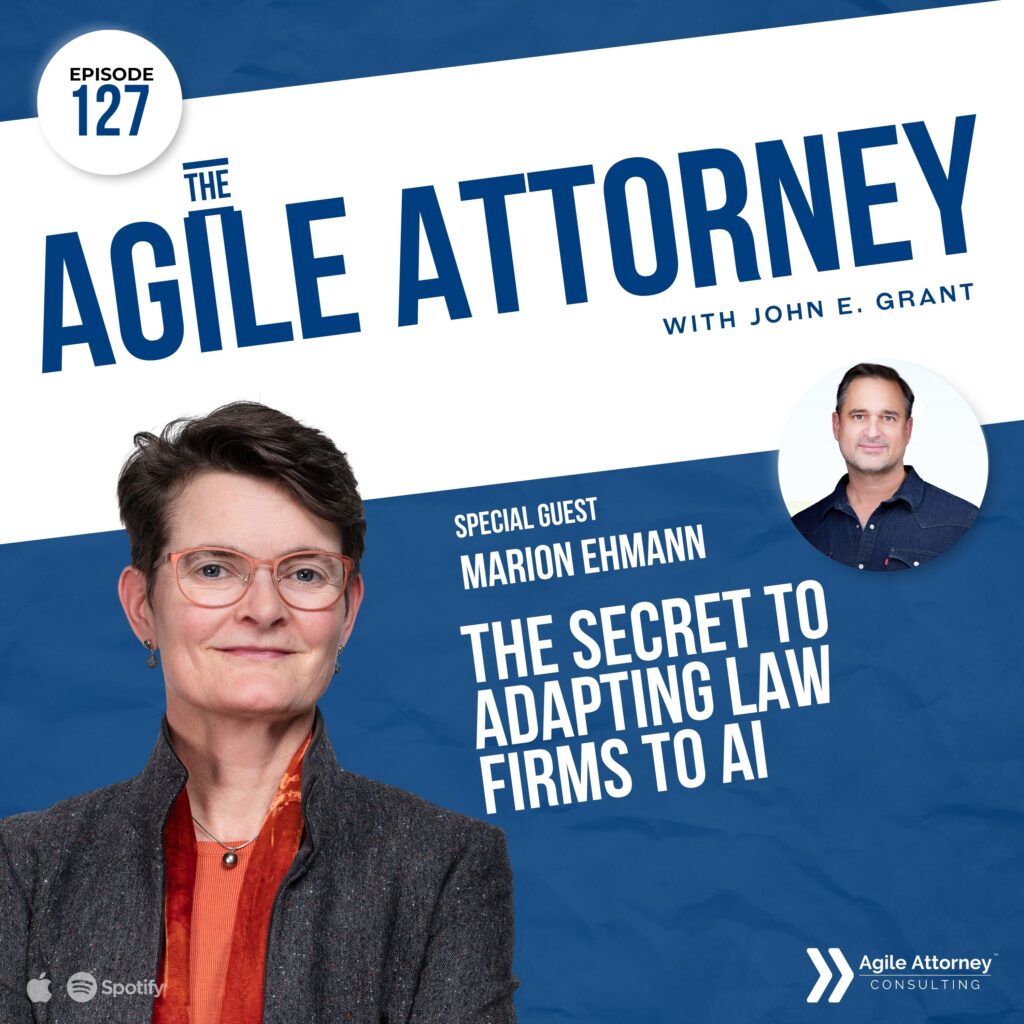
127. The Secret to Adapting Law Firms to AI with Marion Ehmann
Show Notes
AI is transforming the legal profession, but adopting new technology isn’t just about tools. It requires a mindset shift. Without structured approaches, lawyers can struggle to keep up with rapid technological change, meet evolving client expectations, and maintain quality and efficiency in their work. Understanding how to integrate AI into legal workflows effectively is key to sustainable transformation.
In this episode, I speak with Marion Ehmann, partner at Venturis Consulting Group and a leading expert in legal process improvement. We explore how Agile methods provide the structure law firms need to experiment, adapt, and iterate when integrating AI and other tools into their practices. Marion shares examples from legal teams using Kanban boards and Scrum-inspired feedback loops to make work visible, identify bottlenecks, and create learning loops that improve productivity, morale, and client satisfaction.
If you’re interested in helping your law firm adapt to AI while strengthening processes and team collaboration, this conversation is a must-listen. You’ll learn how structured experimentation, frequent feedback, and iterative workflow design allow teams to innovate safely, accelerate learning, and deliver higher-quality legal services in a rapidly changing environment.
Take your law practice from overwhelmed to optimized with GreenLine Legal
Follow along on LinkedIn: linkedin.com/in/johnegrant
What You’ll Learn:
- How Agile principles help law firms adapt to AI and changing client expectations.
- Why iterative workflow design and experimentation improve productivity and quality.
- How Kanban boards and Scrum-inspired feedback loops make work and bottlenecks visible.
- The importance of frequent evaluations and lessons-learned exercises in legal teams.
- How structured experimentation allows safe adoption of AI without compromising quality.
- Why translating Agile methods into legal practice (“lawyerese”) is critical for adoption.
- How team-wide engagement in process improvement accelerates learning and collaboration.
Episode Resources
- Marion Ehmann: Venturis Consulting Group | LinkedIn
- Agile Lawyering 101 Series
Current Resources and Offers
Work with John E. Grant, the world's leading expert on Agile Attorney practices.
Transcript
Read Transcript
John: You know, I've always thought of myself as the world's biggest fan of taking an Agile approach to managing a law practice, but after speaking with today's guest, Marion Ehmann, I'm no longer sure that's true. While I advocate that Agile is a better way to run a legal team, Marion's taken it a step further, making the case that it is almost impossible to truly adapt a law practice to new technologies, especially artificial intelligence, without also adopting an Agile approach to managing legal work. And I think she's right.
You're listening to The Agile Attorney Podcast, powered by GreenLine. I'm John Grant, and it is my mission to help legal professionals of all kinds build practices that are profitable, sustainable, and scalable for themselves and the communities they serve. Ready to become a more Agile Attorney? Let's go.
A quick note: the concepts from today's episode should be useful to you no matter what kind of law practice you're part of or what tools you use. If you'd like, stay tuned at the very end where I will briefly talk about how my software tool Greenline supports the principles and practices from today's show.
Marion Ehmann is a partner at Venturis Consulting Group in Stockholm. She spent more than 20 years as a practicing lawyer, including stints at Clifford Chance in Germany and one of Sweden's leading firms, Vinge. Today, her focus is on legal process improvement and operations consulting. She holds multiple certifications across coaching and project management. And for the past year, she's been making a focused public argument that Agile methods aren't just useful for legal teams, they're the missing infrastructure that makes AI adoption work. She and I have been colleagues in the legal innovation space for some time, and I was delighted to have her join me on the podcast.
And I actually want to read a quote from one of your LinkedIn posts that really jumps out at me. And you say this, quote, "Just implementing new tools and hoping they will magically produce what clients value is not enough. Instead, law firms need to redesign their workflows, pricing models, service delivery, and incentives." So, what do you mean by that and how does an Agile approach help legal teams produce those things?
Marion: In my view, Agile is the perfect match for the challenges and the opportunities that AI brings for the legal profession. I think we are all starting to realize that AI is not just a new technology, it sparks a transformation. And this transformation process in the legal profession will leave almost no stone unturned, neither in legal departments in companies or public bodies, or in private law practice.
So AI is changing the expectations of clients, whomever they are, and is changing the way legal work gets done, and it will change the pricing and the staffing and how we train the next generations of lawyers. And as soon as this became clear to me, I remembered why Agile was invented in the software industry in the first place. Agile was invented to adapt to changing requirements and to stay flexible, and I thought, this is exactly what the legal profession needs right now, because the ground has started shifting under our feet and it will keep doing that for years to come.
AI tools develop at very high speed, making it extremely difficult for lawyers to keep up. So, lawyers now need to develop the ability to constantly adapt to these tools, and that's a big challenge because lawyer culture is rooted in tradition and precedent. We have always learned from our elders, a bit like craftspeople developed from apprentice to journeyman to master under guidance of an older person. That no longer works.
And then something jumped out at me in the spring this year, someone from the legal tech sphere said, or advised lawyers, "Get comfortable with uncertainty and stay willing to experiment." Well, that's much easier said than done, and I think we all know, you know and I know, how deeply uncomfortable lawyers are with uncertainty. And that's quite understandable. After all, it's our job to prevent or control uncertainty. And use the word "experiment" to lawyers and they will take like three steps back.
So, they need to experiment, not with the outcomes. The outcomes have to be according to lawyer's standards, like your briefs will still need to be convincing and you have to meet deadlines and contracts need to safeguard your clients. But the experiments have to happen on the way how to produce those outcomes in a better way according to new expectations while safeguarding the quality of our work and the specific duties we have as lawyers. And that's where Agile comes in very, very handy. Because Agile provides a structure for safe-to-fail experiments, and they create learning loops. So, if Agile hadn't been invented already, we would have to invent it now.
John: Yeah, I love so much about that. And I think I've been talking about Agile in legal for, I don't know, 15 or more years now, maybe longer. I think one of the things that I ran into in the early days is that people didn't quite know how to slot Agile thinking into the work they already did. And for me at least, one of the easiest places to position it was as a legal project management framework, because that was something that was kind of big at the time. The rise of this notion of legal project management was new and popular, but it never quite fit as well as I would have liked.
And I think what you just said actually exposes that, which is my understanding and as my comfort and familiarity and obviously, I'm always learning too, but I think that Agile is fundamentally sort of a product development toolset, and then also a product delivery toolset. It's not really about project management, it is about the delivery of the value that whatever it is that your process is designed to deliver. And I wonder if that framing resonates with you and if it maybe amplifies this idea that as we're in a world where expectations are changing, including expectations about what is a legal product, that this is kind of why Agile is primed to have a moment in our industry.
Marion: I think it's something that goes way beyond project management, so I agree with you on that. It puts customer satisfaction or client satisfaction in our world, front and center and collaboration with our clients. It helps to improve productivity and also morale in teams. So I just think it's a perfect fit for this quite challenging situation that the legal profession finds himself in right now. And of course, Agile needs to be adapted for the legal profession. It needs to be, so to speak, translated into lawyerese. And there is also a bit of "not invented here" bias to overcome. That's why I write and talk so much about Agile methods for legal teams to bridge that gap. And I happen to speak lawyerese in English, German, and Swedish.
John: Yes, which is two more languages than I have under my belt. That's interesting and I love it. I mean, I guess part of what's always attracted me to Agile is it really does center the humanity of things, right? We're talking about customer value, worker engagement, problem solving, and all of these obviously can be done alongside technology tools, including increasingly AI, and I agree with you that AI does change the overall calculus, although it's also not lost on me that the whole rise of Agile in the technology industry came from a similar sort of seismic shift around the new distribution model that became possible using the internet versus moving physical media around the world in the old ways.
So for legal teams or law firms, what are the places that you like to start when you're helping them sort of adapt not just an Agile way of working, but really a more Agile mindset, because it is a mindset shift.
Marion: Right now, several situations come to my mind in a training or consulting setting. I could almost see the light bulbs over people's heads being switched on. So there was one group of lawyers, they were working for a Chamber of Commerce, so they were like a small law firm, both supporting their own organization as a kind of legal department, but also working for external clients. And I showed them how to visualize their workflows with Kanban and then I noticed that some team members' eyes started to shine while the team leader, she started to squirm a bit uncomfortably in her chair.
And everyone immediately understood that this visualization will make the bottleneck, which was the team leader who had to review the work, visible. But they also understood that they needed to fix this situation together. And that's what I like about Agile, like fix the process, don't try to fix the people. Because usually people are fine and the process is broken. So that was a light bulb moment and especially the Kanban board, and I know you talk a lot about it on your pod, it's a really powerful tool to start a legal team on their Agile journey.
So another example, last fall, I had three dispute resolution teams in a large law firm in a training. They were handling very complex litigation and arbitration cases. And I made them try out a Kanban board. So we had one team in every corner of the room, all hands on the board as it should be. And after the exercise, a young lawyer said, "Oh, I love this. Now we can all participate in the planning of the matter together." And next to her, there was a very senior colleague standing there smiling and said, "Yeah, I agree. It's great."
So a Kanban board is a very powerful starting point, but also Lean can be transformative. I remember a legal department of a large business school in Scandinavia and they were a bit downtrodden, feeling pushed around by their professors who wanted special treatment. And when we did some process mapping and clarified their role for the organization, they realized that, hey, we are not the attendants of professors, we are the guardians of the whole organization and its policies. So that too was a powerful starting point for their Agile journey.
John: The thing that I love, right? And so a Kanban board, even a very simple one, and I think you and I have had similar experiences with that light bulb going on in people's eyes, where obviously when we map a knowledge work process, like a legal process onto a Kanban board, it's a representation, it's a model, but it's a model that people almost immediately find familiar, number one. And number two, it almost immediately starts reflecting hard truths back at them.
And the thing that I say sometimes is when I work with a team and we get their work mapped onto a Kanban system for the first time, the first reaction I notice is almost always one of relief because they say, "Oh, finally, I can see my work, I can see my process. This begins to make sense to me or it makes so much more sense to me in this visual method than it did when I was just trying to sort of hold it in my brain or read it through on my process documentation and things like that."
And then I joke that feeling of relief lasts for about 90 seconds because the next thing that people start to see is, "Oh my gosh, there's problems here." And maybe it's the bottleneck that you mentioned before, maybe it's that there is an overwhelming amount of work in total, but whatever it happens to be, people almost immediately start diagnosing problems. And that's a good thing, right? They felt the relief and now they almost immediately understand the utility of the tool.
The other thing that I think is so powerful in the stories that you told is that the recognition was broadly dispersed through the team. There's something about visualizing the work and sitting in a room together and looking at it up on the wall or on a screen if you're using a digital tool, and it's not you and your team sort of looking at each other trying to diagnose a problem in a way that feels like a personal, almost accusation. It's everyone physically turning their bodies and orienting themselves to this representation, and it allows them to engage in co-creation of both identifying the problem and then starting to brainstorm ways and experiments to run to be able to solve it.
Marion: Yeah, it reminds me a bit of my work as a coach for lawyers because when you coach someone, you are sort of standing next to that person and you're both looking at the situation or the problem. So it's a powerful shift of perspective.
John: Absolutely. Well, what are some other circumstances? I mean, especially with the rise of AI and the fact that it is changing so many things. Let me actually come all the way back to one of the things you started with, which is client expectations are changing. And so how does an Agile approach to producing and delivering legal work help a team stay more on top of changing client needs or client expectations?
Marion: I think there we can get inspired a lot from the Scrum toolbox, which is probably the one from the Agile methodologies that is the most alien to lawyers and needs the most explanation, but I think it's also the most powerful one now for the GenAI age. So, by getting inspired to do retrospectives and reviews, asking your clients quite often, what do you need? How can we help you better? Whether that's in matters or between matters or like on a fixed schedule every six months or so. Because clients, they know that their world is shifting too with GenAI, and a lot of in-house counsel that I talk to say, "Sure, I use AI every single day." But they don't know either where this train is going. They don't have a plan. They only know that something is happening and of course they will turn to the external law firms that serve them and say, "Can this be done better, quicker, cheaper?"
So we are all a bit looking for the path forward. No one can tell any legal organization what they should do now or what they should do in a year from now. We are all trying to find our way. And if you meet people at conferences and have an honest conversation, everyone will admit, "Yeah, we don't know it either." And that's where Agile comes in, because Agile helps you to figure stuff out as you go. Try something, find out whether it works. If it doesn't, toss it aside. If it does, great, let's try something else.
John: Well, and you say toss it aside, it's not, I mean, it can be that simple, but it's actually not that simple because in a lot of ways, when you learn that something doesn't work, that is equally valuable in terms of how you've learned as an organization, learned as an individual, that says, "Okay, great. This is something, at least based on the assumptions that we put into it at the beginning, we probably shouldn't be going down this path." And that's really valuable. It's especially valuable in a world, and I think this comes back to the elements of the Scrum method that work so well, when you have tight feedback loops.
When we reach the end of a sprint, however long that sprint happens to be, we are going to sit down and review what happened and that might be something we will celebrate, that might be something that is really uncomfortable, but either way, we're going to do it and we're going to keep doing it because that's how we get that validated learning along the way.
Marion: Yeah, and that's what I like about it. It's a cadence and it's mandatory. There is no way out. And I've been training and consulting around legal project management and process improvement for 13 years now. I have been preaching about doing more evaluations, but the needle is moving very, very slowly. In the legal profession, we do not evaluate not nearly enough, and to me, that's a tragedy, because there is so much lessons learned that are not captured, that are just being forgotten. There is so much client knowledge that we don't learn. There are so many opportunities to deepen the client relationship that we just let slip through our fingers. And that's tragic.
John: It is, switching over to Lean for a second, it is, I think one of the most profound forms of waste that we could have in a system, which is we have had an opportunity to not only learn something but to genuinely benefit from that learning, and because we either don't value the feedback loop as much as we value the activity, which I think is historically true of legal because we have tended to bill hours and billable hours are the currency of the trade and all the rest, which means that if you're not billing hours, then you're not benefiting the business. But if you don't have that retrospective, it's effectively a maintenance cycle.
Marion: I think it's much more than maintaining the engine. To me, doing evaluations is developing your organization, developing your product line, is business development. So, to me, this is a very high value activity and of course, people tell me regularly, "But we can't bill it." Yes, that's true, but it's an investment in your firm, in your organization. And that's why we really need to get better at doing evaluations and I understand that it's difficult. I mean, it has to do with we don't have the habit, we don't have the tradition, but it also has to do with fear. What if I hear something from a client that I can't handle?
So I try to give legal teams very, very simple tools, how to do a lessons learned exercise, how to sit down with a client and ask just three simple questions, or rather two simple questions, "What did you like?" And "How can we help you better?" And by doing so, I try to demystify and normalize the activity of doing evaluations. And if you've done that a couple of times, you will realize that, yeah, well, that's just the way how we do things. So it does not spark this panic reflex. It's just, "Oh yeah, that's okay, now we do that again. All right, I'll survive also this time."
John: Some of the things you're saying resonate with me. So, going back to two things that you said at go, I think the learning and benefiting from the learning, one of the things that does is it starts to distribute expertise more broadly throughout the organization. And so you are less likely to be in a world where there is a, yes, there's may not be a single decision-maker, there may not be a single expert, but there's also no longer a single point of failure or a single bottleneck that can become the hang-up in the overall process. A thing you just said before I went back two steps though, when you're talking about that client feedback loop in particular, one of the keys to me is that the more frequently you have that feedback loop, the less likely any of the problems that might be happening are going to metastasize into something big and ugly and dangerous.
Marion: Absolutely. And Agile is full of rather simple tools that can create a quite big amount of value compared to the time that you put in. So for example, and I think you've talked about this in your pod, the definition of done and the definition of ready. Love it. This is something that works beautifully for legal teams and also now in the age of GenAI. So, of course, if you have a definition of done for any kind of legal work product that has been produced with the help of AI, your definition of done needs to include the bullets relating to AI, like all the citations have been verified, we tested, we asked another AI to criticize, or we have used AI as the devil's advocate to improve our argumentation. So these tools, the definition of done and the definition of ready are rather simple, but can produce huge amounts of value for legal teams.
Someone said recently, I don't remember who it was, that knowing what not to do will be a very important skill in the AI age. And that's a human skill. Knowing when to stop, when to make your agreement or memo not even longer, when to keep it simple, when to take away things instead of adding. That's a human skill and that requires judgment and a bit of experience, and that's something that will remain in the remit of human lawyers.
John: Yes, absolutely. Well, and I think that one of the concerns that we hear a lot about AI is that how are new professionals, emerging professionals going to learn to build and use that judgment? And I think Agile actually provides a solution to that as well, because Agile, while there are obviously parts of an Agile workflow that do require individual effort and individual work, all of these review meetings, all of these feedback loops tend to be group activities. And when done well, they are group activities. And so even someone who wasn't directly involved in the creation of a particular brief or memo or research note, whatever it happens to be, can still benefit and provide value in that feedback loop, right, whether it's a retrospective, whether it's a review meeting, because number one, the broad perspective is helpful, and number two, the institutional learning that happens among the team when you're engaged in that feedback loop process is so valuable.
Marion: Yeah, it tends to make learning curves steeper, which will benefit especially our young colleagues.
John: Yeah, steeper in a good way in that the learning happens faster, not in that it's harder, right? And in fact, I think in a lot of ways, the learning through group conversation is easier because it comes more naturally as humans, right? We are a social animal, and sitting in a room, and yes, we can do it on Zoom screens, it's not quite as good as being in a room together, but I do think that doing it in real time is essential, which again comes back to the concerns, and maybe I can get you to elaborate a little bit on methods you've suggested to do this, right?
When we're talking about getting a team of maybe five, seven, 10 people in a room together, not only do law firms traditionally see that as a very expensive meeting because if that's if there's that many people not billing hours, that starts to set off some alarm bells in people's heads. It also has a coordination cost. But I'd love to hear how you approach that with some of the teams you're working with.
Marion: Yeah. Of course it has a cost, but I see it as an as an investment. So, let's start with the length of such a lessons-learned meeting. And again, an inspiration from Agile, it depends on the length of the sprint, or rather, in the case of legal work, it depends on the length and the complexity of the matter. So that could be 15 minutes for a smaller matter, or I remember one evaluation lessons-learned meeting that we did many years ago, we had a huge team, and we spent half a day doing evaluation, and that was a very well-spent half day because it was a very complex matter and lots of friction and there were tons of learning to be gathered.
So that's one thing. The length needs to be adapted to the weight of the matter. And then when it comes to methods, I prefer something which I call a "lightly structured meeting," and what I do is I ask everyone to bring at least three post-its, three sticky notes to the meeting. One sticky with one thing that we did well, one sticky with one thing that we can do better, and a third one is whatever you want to write down. And then we put them on the wall and then we have a look and group them and discuss.
What I achieve by doing that is one, I get more data, because a group discussion always narrows down after the first person has spoken, then everyone reacts to that. And depending on who the person is, you know, such discussions can go off on a tangent. So by asking for the stickies, I get much more data points to work with. And the second positive effect is I level the playing field. I give an equal chance to make their views heard also to the people who like to think first in the privacy of their own mind before they speak.
John: I think both of those are true. I would add a third, which is when you go to put them up on the wall and you see the commonalities, then I think that tends to be very engaging for the team, right? They don't feel so isolated, they feel more connected to their teammates, to their colleagues. Or if someone is out in left field—sorry, that's an American baseball reference—if someone is astray, then maybe they will recognize that the rest of the team saw something that they didn't, or maybe the rest of the team will say, "Oh gosh, I'm so glad you brought that up. I didn't put that on my sticky, but that's a really valuable insight. Let's dive in on that for a minute."
Marion: And then, of course, such meetings, especially when a team is new to doing evaluations, they benefit a lot if you have a facilitator or a team leader who takes that role seriously. So for example, when sometimes it can happen that people get stuck in analyzing a problem, what happened back then two weeks ago, and then it's important to shift the focus and focus on, okay, what can we learn from this? How can we prevent this or handle better next time in the future? So you put the spotlight rather on solutions than problems and rather on the future than what happened back then, which also makes it easier for people to not get stressed out because the focus is on learning together for the future and not on who did what to whom back then.
John: Right. It depersonalizes it.
Marion: Yeah.
John: Well, and one other point that I want to make and then I'm going to ask you maybe to end with a success story that you have worked on lately. But I think that running these feedback sessions and regardless of how often you do it, it is a learnable skill, it's a teachable skill, and it's also a muscle that you have to build up. And so the first time you do a retrospective and after action review, a sprint delivery meeting, if that's what you're doing in a pure Scrum environment, it's not going to go perfectly. And not to get too meta about it, but you almost have to do a retrospective on your retrospective and figure out, you know, okay, great, did this method go well? What did we like about it? What did we not like about it? And eventually, well, the more often and the more frequently the team does it, the faster they will find a structure and a cadence and a facilitation style that works for them.
Marion: Yeah, and sometimes it's just valuable to vary the methods. Like if you've done the lightly structured meetings for a couple of times, just try and shift to anonymous written input and see what happens because if we get bored, human beings get bored if we do the same thing again and again. So just routines and see what happens. You probably get more data points to work with.
John: I think there's a site out there somewhere that has like 40 different methodologies for running a retrospective, so there's there's lots of approaches to it. Well, give me a success story if anything comes to mind. Hopefully something does.
Marion: Yeah, I'll give you a success story. It's not one of mine, I can't take credit for it, but this law firm just blew my mind. It's a law firm in Copenhagen that I met recently and they started their Agile journey already in 2017. They are a large boutique, they are doing mainly construction litigation and public procurement work. They have seven owners and they decided back then in 2017 that they wanted to have a different firm. They wanted to combine high performance with sustainable ways of working.
So over the years, they have implemented various ways of working from management, from Agile, in particular Scrum. And the results that they showed to me, they just blew my mind. They grow at the speed of a startup. So they went from 30 people to 80 people in five years, and that's a staggering growth rate for a law firm. So obviously, they are very, very profitable to finance that kind of growth. And everyone goes home, everyone at noon on Fridays for the weekend after they had their weekly all-hands meeting. They blew my mind. Very dedicated people. Of course, it was a journey. They had a, they started with a three-month-long, no-complaints period, just trying out things. And of course, they have worked also iterative on their transformation and have changed things, and they have lost people who said, "I can't work like this." But with that growth rate, they must be doing a lot of things right. And I love that story.
John: I do too. That's inspiring. It brings to mind other examples and we don't have time to go into them. So, Marion, thank you so much for coming on the podcast and sharing your perspective. I'd love to continue the conversation, obviously, offline, but maybe at some point we can have you back on and we can go a little deeper on some of the tools as well.
Marion: I'd love to do that. Thank you very much, John. This was a delight.
John: So, as you can probably tell from that interview, Marion and I both love that moment when a legal team sees their work on a Kanban board for the first time and their eyes light up because the full extent of their delivery pipeline finally makes some sense. And that's exactly what Greenline is designed to do. Even the parts where things get a little uncomfortable because the team is finally recognizing that the discomfort is actionable. Greenline is a Kanban-based practice management platform built specifically for law firms. It puts your matters on a visual board, it makes your workflow visible, and this is the key, it makes bottlenecks visible without making it personal. The board shows the constraint and then the team can solve it together.
Greenline also supports the kinds of feedback loops Marion and I discussed today, including service level expectations and the performance tuning report, which gives you data on where work is flowing and where it's getting stuck. So if you want to start your Agile lawyering journey, whether it's to help your team incorporate new technology or just get better at using the practices you already have with a Kanban board, Greenline is built for exactly that. To learn more, head on over to greenline.legal and look for that "book a demo" button, or just reach out. I'd be happy to talk about it with you and you can reach me at john.grant@greenline.legal.
All right. Well, Marion and I could have kept going, and I suspect someday we will because I would love to have her back to go deeper on some of the specific tools she mentioned, especially around Scrum practices adapted for legal because that's something that I've actually struggled with a little bit. I'm not always convinced that Scrum is the best technique, but I want to learn more about where she's finding success.
For today, my core takeaway is this. AI is not a plug-and-play productivity upgrade. It is a forcing function for rethinking how legal work gets designed and delivered. And Agile, Kanban, Lean, the Scrum-influenced approach, all of these tools give you the structure to do that rethinking in a way that is predictable, iterative, and sustainable at a human level.
If today's conversation resonated with you, I'm going to encourage you, first and foremost, go follow Marion on LinkedIn. Her series about Agile legal has been going deep on tools and frameworks that she and I discussed today. I'll put a link to her profile in the show notes. And of course, if you are based in Europe and you want to work with Marion directly, I'll put that link into the show notes as well. She'd be a great person to call.
Of course, for more on my own thoughts on Agile for legal teams, I'd love to have you follow this podcast in your favorite player. Or if you're a new listener or new to Agile overall, I'd encourage you to go listen to my Agile Lawyering 101 series starting, conveniently, with episode 101 in this podcast feed.
As always, this podcast gets production support from the great team at Digital Freedom Productions, and our theme music is “Hello” by Lunareh. Thanks for listening, and I will catch you again next week.